
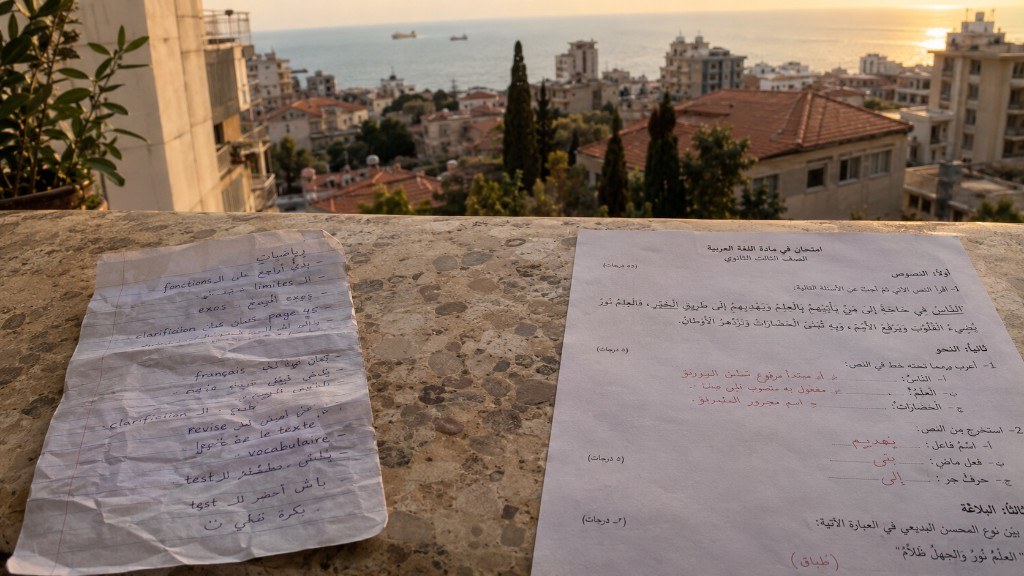
A child in Lebanon speaks Arabic at home every day. Then school asks for formal written Arabic, and the same child struggles. Parents often hear that the problem is effort, attention, or a lack of practice. The research points somewhere else. Arabic is a diglossic language. The Arabic a child speaks in Beirut, Tripoli, or Sidon is not the same Arabic used in textbooks, exams, and formal writing. That gap is real, and it affects reading and writing long before it affects conversation. This guide explains why Arabic literacy in Lebanon is hard even for native speakers, how Lebanese schooling adds pressure, and what parents can do at home and through targeted support.
The Real Gap Behind Arabic Literacy Struggles in Lebanon
Diglossia describes a language situation where two varieties of the same language coexist. One variety is used for formal writing, education, and public discourse. The other is used for ordinary conversation. The linguist Charles Ferguson described this pattern in 1959, and Arabic is one of the clearest examples.
In Lebanon, the spoken variety is Lebanese Arabic. The formal variety is Modern Standard Arabic, often called MSA. MSA is the language of textbooks, exams, news broadcasts, and official documents. It is also nobody’s native language. Children learn Lebanese Arabic at home. They learn MSA at school, as a subject and as a written system.
The two varieties differ in vocabulary, grammar, morphology, and sentence structure. MSA has case endings, mood marking, dual number, passive voice, and a large formal lexicon. Lebanese Arabic has simplified much of that system, uses different pronouns and word order tendencies, and borrows heavily from French, English, Turkish, and other languages. A simple example helps. MSA says “uridu an adhhaba ila al-madrasa.” Lebanese Arabic says “baddi rouh al-madrase.” The meaning overlaps, but the grammar and everyday vocabulary are far apart.
This is not a small register shift, like changing how you speak at a wedding versus a job interview. It is a learned parallel system. That is why a child can sound fully fluent at home and still find formal Arabic reading and writing difficult.
Why Diglossia Makes Reading and Writing Harder Than Speaking
Speaking a language and reading it are different skills. Reading and writing in MSA require a student to decode an unfamiliar written form, recognize formal vocabulary, process complex grammar, and produce accurate text. The spoken variety helps with meaning and general language awareness, but it does not automatically transfer to formal literacy.
Research on Arabic reading development has shown that the distance between spoken Arabic and MSA affects early reading acquisition. Elinor Saiegh-Haddad and other researchers have studied how this linguistic distance shapes decoding, vocabulary, and reading comprehension. The gap is not only about knowing more words. It is also about learning a different grammatical system and a different set of written conventions.
For parents, the practical point is simple. A child who struggles with formal Arabic is not rejecting their mother tongue. They are doing something cognitively harder than learning to read a language they already speak at home. They are learning to read a language that is close to their spoken language in some ways and very far from it in others.
The Trilingual School Structure Adds Pressure
Lebanese schools typically teach Arabic and a foreign language, usually French or English. In many schools, math and science shift to French or English as the medium of instruction at some point in the intermediate grades. The exact timing and the weekly hours vary by school, track, and grade level. The official curriculum is set by the Center for Educational Research and Development (CRDP) under the Ministry of Education and Higher Education.
This structure means many Lebanese students are managing three languages: spoken Lebanese Arabic, formal MSA, and French or English. Each language has a different role. Lebanese Arabic is the language of home and friendship. MSA is the language of formal reading, writing, and exams. French or English is the language of science, math, and often higher education or employment.
The pressure is not evenly distributed. A student may become strong in French or English because those subjects use more interactive methods and because the language feels useful for the future. The same student may see Arabic as a school requirement rather than a living skill. That perception can reduce practice, and reduced practice slows literacy growth.
The research generally distinguishes between spoken fluency and academic literacy. A student can be fluent in Lebanese Arabic and still struggle with MSA reading and writing. The school structure can make that gap worse if Arabic instruction is isolated from the rest of the curriculum and if students rarely use MSA for meaningful communication.
Beyond Diglossia: Teaching Methods, Economics, and Attitudes
Diglossia is a major factor, but it is not the only one. Linguists and education researchers point to several other causes.
Teaching Methods
Arabic is often taught with a strong focus on grammar, memorization, recitation, and classical texts. French and English are often taught with more communicative and interactive methods, including group work, projects, and everyday conversation. This contrast can make Arabic feel like a difficult heritage subject rather than a usable language.
Researchers such as Kassim Shaaban, Rima Bahous, and Nola Bacha have written about language education in Lebanon. Their work and related regional research suggest that method matters. When students experience Arabic as a living language with real purposes, engagement and literacy outcomes tend to improve. When Arabic is only a set of rules to memorize, many students disengage.
Home Literacy and Economic Context
Early exposure to books, stories, and rich language at home predicts later literacy. Students who grow up with books, reading routines, and adults who talk with them about ideas have an advantage. Students without that exposure face a larger gap when formal MSA instruction begins.
In Lebanon, economic inequality and the financial crisis since 2019 have made access to preschool, books, tutoring, and stable schooling harder for many families. Reports from the World Bank and UNESCO document these pressures across the region. The result is that some students get more support at home and in school, while others get less, and the literacy gap widens.
Attitudes Toward Arabic
Language attitudes also matter. Research on language attitudes in Lebanon has found that many students and families perceive French and English as more socially and professionally valuable than Arabic. Arabic may be associated with tradition, religion, or officialdom. French and English may be associated with prestige, study abroad, and employment.
Yasir Suleiman and other scholars have written about language and identity in the Arab world. When students believe that formal Arabic will not help them in their future, they may invest less effort in it. That attitude does not cause the literacy struggle by itself, but it can make the struggle harder to overcome.
Code-Switching and “Arabinglizi”
Code-switching is common among Lebanese students. The informal label “Arabinglizi” describes mixing Arabic, English, and French in the same conversation. Research on code-switching shows that it is often functional. It can help speakers communicate, express identity, and manage different social situations. It is not automatically harmful.
The relationship to formal Arabic literacy is mixed. Code-switching can support metalinguistic awareness, which is the ability to think about how language works. That can be useful. But if students rarely practice sustained MSA production, code-switching can become a way to avoid formal Arabic. The key is balance. Students need opportunities to use MSA in meaningful ways, not only in grammar drills.
What This Means for Academic Performance
Weak formal Arabic literacy can affect more than the Arabic class. In Lebanon, subjects such as history, civics, geography, and religious education may require Arabic comprehension. If a student reads MSA slowly or with difficulty, those subjects become harder too.
There is limited public research that directly links Arabic diglossia to Brevet or Baccalaureate Arabic exam scores. CRDP publishes official exam results, and parents can check those directly. But exam data alone does not prove causation. It shows patterns, not the full story.
International assessments such as PIRLS and PISA provide broader reading data. Lebanon has participated in these assessments. They are useful starting points, but they do not isolate MSA literacy cleanly because test language and school track complicate the picture. The general finding from literacy research is that reading proficiency predicts broader academic performance. When formal reading is weak, other subjects often feel harder as well.
Weak formal Arabic literacy can also affect confidence. A student who struggles to read and write MSA may avoid participating in class, avoid reading for pleasure, and develop a negative academic self-concept. That emotional effect can be as important as the technical reading gap.
What Actually Helps: Evidence-Based Approaches
Literacy research on diglossic languages points to several approaches that can help students build formal Arabic literacy.
What Schools Can Do
First, bridge the spoken variety and MSA explicitly. Students benefit when teachers show how Lebanese Arabic and MSA differ and how they connect. Second, use contrastive analysis. This means comparing the two varieties in vocabulary, grammar, and structure so students understand the system. Third, build metalinguistic awareness. Students who can think about language are better prepared to learn a formal variety.
Fourth, build oral language alongside reading and writing. Rich oral work in MSA, including storytelling, discussion, and presentation, gives students a foundation for formal literacy. Fifth, teach phonics and morphology in ways that fit Arabic. Arabic has a root-based morphology system, and students benefit from understanding how words are built. Sixth, provide extensive reading of age-appropriate MSA texts. Seventh, teach writing as a process with feedback, revision, and real purposes.
Researchers such as Mohamed Maamouri and Elinor Saiegh-Haddad have written about these approaches. Programs in other Arabic-speaking countries have shown that teacher training, structured materials, explicit oral MSA support, and frequent practice with feedback are key ingredients.
What Parents Can Do at Home
Parents do not need to be Arabic teachers to help. Reading aloud in MSA, even for ten minutes a day, builds familiarity with formal vocabulary and sentence structure. Keeping MSA books, magazines, and children’s stories at home makes formal Arabic part of daily life. Quality MSA media, such as news programs for children or audiobooks, can also help.
Parents can play word and vocabulary games, encourage writing for real purposes such as letters, journals, or family stories, and talk about the differences between spoken and written Arabic without treating the spoken dialect as wrong. The goal is positive exposure, not correction. If the school does not bridge the gap, targeted tutoring can provide structured practice and feedback.
What to Look for in Tutoring
Look for a program that is structured, curriculum-aligned, and focused on measurable progress. The tutor should understand diglossia and know how to bridge Lebanese Arabic and MSA. Sessions should include reading, writing, vocabulary, grammar in context, and oral MSA practice. Progress should be tracked, and feedback should be specific. A good program will not promise overnight results, but it will show steady improvement over time.
How Mou3alem Supports Formal Arabic Literacy
Mou3alem offers structured, curriculum-aligned Arabic tutoring for Lebanese and French-system students. Our approach connects the Arabic your child already speaks to the formal Arabic they need for school. We focus on reading, writing, vocabulary, grammar in context, and steady progress tracking.
If your child struggles with formal Arabic, you can explore our Arabic tutoring in Lebanon page. To see how our method works, visit Structured Method. To understand how we track progress, see Progress Tracking. For exam-focused support, visit Exam Preparation. When you are ready, you can book an assessment session. The assessment is the starting point. It is not a free trial.
The Bottom Line
Arabic literacy struggles among native speakers are not a mystery and not a sign of laziness. They are the predictable result of diglossia, a trilingual school structure, teaching methods, economic pressure, and language attitudes. The gap between spoken Lebanese Arabic and formal MSA is real, and it makes reading and writing harder than speaking.
The good news is that the gap can be bridged. Explicit instruction, rich oral MSA practice, extensive reading, writing with feedback, and structured tutoring all help. Parents can support formal Arabic at home by making it part of daily life and by treating the spoken dialect as a strength, not a problem. With the right approach, students can build the formal Arabic literacy they need for school and beyond.
FAQ
Is Lebanese Arabic bad for learning MSA?
No. Lebanese Arabic is the child’s native language and a valuable foundation. The issue is that MSA is different enough that it must be taught explicitly. The spoken dialect does not need to be removed. It needs to be used as a bridge.
Should we stop speaking Lebanese Arabic at home?
No. Speaking the dialect at home supports language development, identity, and communication. The goal is to add formal Arabic exposure, not replace the home language.
How long does it take to improve formal Arabic literacy?
It varies by student, age, and starting point. Steady practice over months usually produces visible progress. Structured tutoring with progress tracking can make the process more efficient.
Does tutoring help with Arabic literacy?
Yes, when it is structured and focused on the specific gap between spoken Arabic and MSA. Tutoring can provide the explicit instruction and practice that a busy classroom may not have time for.
What if my child is strong in French or English but weak in Arabic?
That pattern is common in Lebanon. It often reflects the school structure and language attitudes rather than a lack of ability. Targeted Arabic support can close the gap without weakening the other languages.
Sources and further reading
- Ferguson, Charles. “Diglossia.” Word, 1959. DOI
- Maamouri, Mohamed. Language Education and Human Development. World Bank, 1998. World Bank
- Saiegh-Haddad, Elinor. “Linguistic distance and initial reading acquisition.” Applied Psycholinguistics, 2003. DOI
- Center for Educational Research and Development (CRDP). crdp.org.lb
- Ministry of Education and Higher Education (MEHE). mehe.gov.lb
- PIRLS. timssandpirls.bc.edu
- PISA. oecd.org/pisa
- UNESCO. unesco.org
- World Bank. worldbank.org