
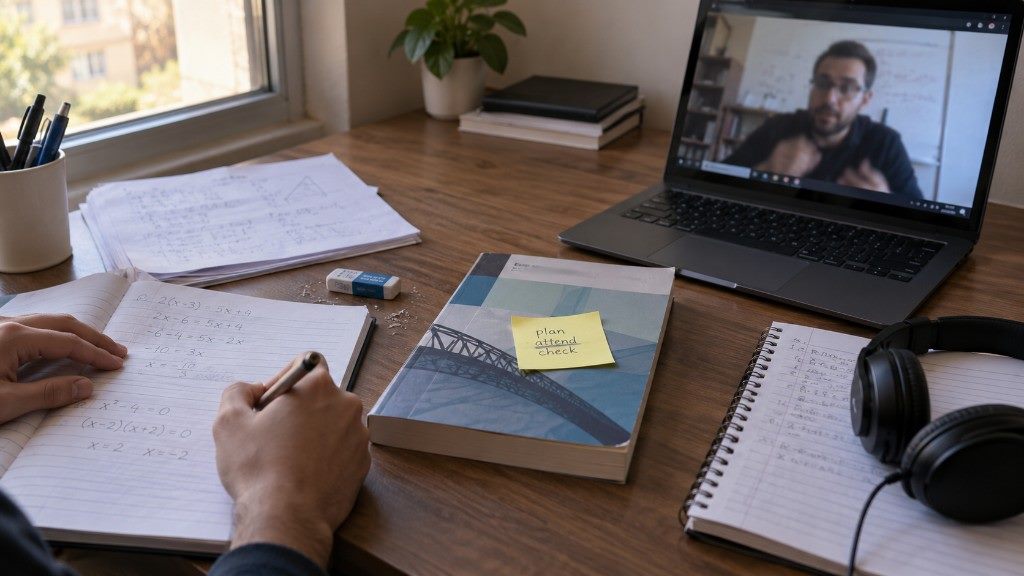
Parents in Lebanon often ask the same question before choosing a tutor: Is online tutoring as effective as in-person tutoring?
The format does not move the grade needle by itself. The research does not support a simple winner.
Tutoring itself has a strong evidence base. But when researchers compare delivery formats, the picture is more nuanced. A well-designed online program can produce meaningful gains, including in secondary-school mathematics. In-person tutoring can make attendance, rapport, and supervision easier for some students. What matters most is usually not whether the tutor is on a screen or across the table. It is how the tutoring is designed and delivered.
For families choosing between formats, the more useful question is: Which setup is most likely to give this student consistent, high-quality instruction?
What the research says about academic results
Large reviews consistently find that tutoring can improve academic performance.
A 2023 meta-analysis published in the American Educational Research Journal reviewed 89 randomized studies and found an average tutoring effect of about 0.29 standard deviations across academic outcomes. The gains appeared across literacy and mathematics, although results varied by age, program design, and implementation. Read the study.
A newer 2026 meta-analysis examined 263 randomized controlled trials. The pooled effect across the full sample was about 0.40 standard deviations. When the authors focused on larger-scale programs and independent standardized tests, the estimates fell to about 0.16 to 0.22 standard deviations. That matters because tutoring can look stronger in tightly controlled studies than it does when expanded across real school systems. Read the study.
The important point is that tutoring works best as a structured intervention, not simply because it happens online or in person.
Does in-person tutoring produce better grades?
The strongest direct comparison so far does not show a clear academic advantage for either format.
In a 2025 randomized study of an early-literacy program, students were assigned to receive the same tutoring remotely or in person. Researchers found no statistically significant difference in literacy growth between the two groups. The estimated in-person advantage on one assessment was only 0.03 standard deviations and was not statistically significant. Read the study.
That finding is useful, but it needs context. The study involved younger children in Grades 1–3 and focused on early literacy. It cannot prove that online and in-person tutoring are equivalent for every subject, age group, or exam.
The broader 2026 meta-analysis also found lower raw effect sizes among virtual programs than in-person programs. But the authors warned against treating that as proof that online tutoring is inferior. Virtual tutoring represented only a small share of the evidence base (about 3% of programs), and the apparent gap became statistically insignificant after accounting for other program characteristics.
So the evidence is still mixed on delivery mode itself.
Can online tutoring produce meaningful gains?
Yes. Several randomized trials show that it can.
In Italy, researchers evaluated the Tutoring Online Program for disadvantaged middle-school students. Three hours per week of individual online tutoring improved mathematics performance by about 0.23 standard deviations in the first study and 0.20 standard deviations in a later replication. Higher dosage produced stronger results. Read the NBER paper.
A 2024 randomized trial in Spain studied 375 disadvantaged students in Grades 7–8 who received fully online mathematics tutoring, generally in groups of two. The program increased standardized mathematics scores by about 0.26 standard deviations and improved end-of-year mathematics grades by about 0.49 standard deviations. Students were also more likely to pass mathematics and less likely to repeat a grade. Read the study.
Those are meaningful results. They also show why families should avoid treating “online tutoring” as one single method. The successful programs were structured, frequent, and academically focused.
By contrast, another online tutoring trial involving middle-school students used two 30-minute sessions per week for 12 weeks. The estimated effects were small and not statistically significant. Read the study.
The format was still online. The outcomes were different.
That is exactly why program design matters.
Where in-person tutoring still has a real advantage
Even when test-score differences are small, in-person tutoring can solve practical problems that affect learning.
In the 2025 randomized online-versus-in-person literacy study, students assigned to in-person tutoring received about 1.8 more sessions on average, roughly 15% more instructional exposure. Tutors also reported substantially stronger relational closeness with in-person students.
That did not translate into a statistically significant achievement advantage during the study. But it highlights two areas where being physically present can matter: attendance and rapport.
In-person tutoring may therefore be a stronger fit when a student:
- struggles to attend or remain engaged during remote sessions;
- needs close adult supervision to stay on task;
- has unreliable internet, audio, or device access;
- works better with physical materials or handwritten problem-solving;
- finds it difficult to build rapport through video.
The Education Endowment Foundation’s National Online Tuition Pilot reported similar implementation challenges. Tutors said rapport could be harder to establish online, and technical problems sometimes interrupted lessons. At the same time, students were not broadly negative about the format: 87% said they would like to continue tutoring if given the opportunity, and 76% said they enjoyed learning more than before. Read the EEF evaluation.
So “students cannot focus online” is too broad. Some cannot. Many can. The decision depends on the student and the quality of the setup.
What actually makes tutoring effective
The research is clearer about this than it is about online versus in-person delivery.
Effective tutoring tends to share several features: regular sessions, sufficient total instructional time, small student-to-tutor ratios, curriculum alignment, targeted feedback, progress monitoring, and consistent attendance.
A 2024 evidence synthesis from EdResearch for Action recommends high-impact tutoring models that typically provide three or more sessions per week for at least about ten weeks. For older students, sessions often last around 30–60 minutes. Read the research brief.
The 2026 tutoring meta-analysis reached a similar conclusion. Programs combining high-impact features such as very small groups, multiple sessions per week, at least 15 intended hours, a defined curriculum, and strong implementation, produced stronger outcomes than weaker or less consistent models.
The Education Endowment Foundation also emphasizes that tutoring is more likely to work when it is connected to what students are learning in school, focused on identified gaps, and adjusted based on progress. Its evidence review estimates that one-to-one tuition can produce the equivalent of several additional months of progress on average, although that figure includes many different tutoring formats. Read the EEF evidence review.
This is the practical distinction parents should pay attention to.
Structured tutoring usually means scheduled sessions, defined learning objectives, consistent tutor assignment, curriculum alignment, progress checks, and follow-up when the student misses a session.
Informal tutoring may simply mean getting help whenever the student decides to ask for it.
The second model can still be useful. But research on optional, on-demand tutoring shows that take-up can be low, especially among students already struggling academically. Access alone is not the same as participation.
What about exam preparation?
This is one area where the evidence is thinner than many tutoring websites imply.
There is substantial research on tutoring and on test preparation in general, but there are very few rigorous studies that directly compare online versus in-person human tutoring specifically for school-leaving or standardized exams.
The Education Endowment Foundation’s National Online Tuition Pilot included many students aged 14–16 preparing for GCSEs in mathematics, English, and science. But the project was designed mainly to test whether online tuition could be delivered effectively during school closures, not to prove a causal increase in GCSE scores.
That means parents should be careful with claims such as “online exam tutoring is proven to raise scores more than in-person tutoring” or the reverse. The evidence does not currently support either statement.
For exam preparation, the same structural questions remain more useful:
- Does the tutor know the exact curriculum and exam format?
- Are sessions built around diagnosed weaknesses?
- Is there enough frequency and repetition before the exam?
- Are timed practice and past-paper work included?
- Is progress being measured?
For Lebanese and French-system students, curriculum alignment matters even more because exam preparation must match the student’s actual program, not a generic international syllabus. Parents can review Mou3alem’s Exam Preparation and Structured Method pages for how that process can be organized.
Online tutoring wins on access, but only when the technology works
The clearest advantage of online tutoring is reach.
A student is no longer limited to tutors who live nearby or can travel to the home. That can be especially useful for families outside major cities, students following a specialized curriculum, or students who need a tutor in a less common subject.
Research organizations such as Stanford’s National Student Support Accelerator note that virtual delivery can widen the potential tutor pool and reduce some delivery costs because tutors do not need to be recruited locally. See the Stanford guidance.
The Education Endowment Foundation has also reported that online tuition can cost less than in-person provision in institutional programs. But there is no credible universal percentage showing how much cheaper online tutoring is for families. Retail prices vary heavily by tutor experience, subject, country, session length, and provider.
Online tutoring also has a clear weakness: access depends on technology. In the EEF online tuition pilot, 48% of participating schools reported lack of equipment as a challenge, and internet connectivity was another recurring problem.
So online tutoring removes travel barriers, but it can create device and connectivity barriers instead.
Is online tutoring as effective as in-person tutoring?
There is no evidence-based reason to assume that one format always produces better grades.
A strong online tutor can outperform a weak in-person tutor. A well-structured in-person program can outperform an inconsistent online one. The delivery channel matters, but it is only one part of the equation.
For most middle- and high-school students, parents should focus first on the factors that research repeatedly links with stronger outcomes:
- Tutor quality and subject knowledge
- Curriculum and exam alignment
- Regular attendance
- Enough weekly instructional time
- One-to-one or very small-group attention
- Progress tracking and feedback
- A format the student will actually use consistently
If both online and in-person options meet those conditions, the choice can come down to the student’s learning habits, schedule, technology, and preference.
That is a more evidence-based decision than choosing a format based on assumptions alone.
For families considering online support, Mou3alem explains its process in How Online Tutoring Works and how student progress can be monitored through Progress Tracking.
FAQ
Is online tutoring as effective as in-person tutoring?
Research does not show a universal winner. One randomized head-to-head study found no statistically significant difference in academic growth, while broader reviews show that program quality, dosage, attendance, tutor quality, and curriculum design strongly influence results.
Is online tutoring good for mathematics?
Yes. Randomized studies with secondary-school students in Italy and Spain found meaningful mathematics gains from structured online tutoring. The important factor was not simply being online. The programs were frequent, targeted, and academically structured.
When is in-person tutoring the better option?
In-person tutoring may be preferable when a student struggles with remote attention, has poor internet or device access, needs stronger supervision, or finds it easier to build rapport face to face.
How many tutoring sessions per week are most effective?
Research on high-impact tutoring commonly points to several sessions per week rather than occasional help. Three or more sessions per week is a common benchmark in research-based tutoring models, although the ideal schedule depends on the student’s age, subject, and academic need.
Is online tutoring cheaper than in-person tutoring?
It can be, mainly because travel and geographic limits are reduced. However, there is no reliable universal percentage difference for families. Prices vary by subject, tutor experience, market, and provider.
Final takeaway
The format does not move the grade needle by itself. The tutoring model does.
Online tutoring can produce strong academic gains when it is structured, frequent, curriculum-aligned, and delivered by a capable tutor. In-person tutoring can make attendance, rapport, and supervision easier for some students.
Parents should therefore choose the format that makes high-quality tutoring easiest to deliver consistently.
If online tutoring is the better practical fit for your family, explore Mou3alem’s Academic Support or Book a Session to see how a structured tutoring plan can be built around the student’s curriculum and learning needs.