
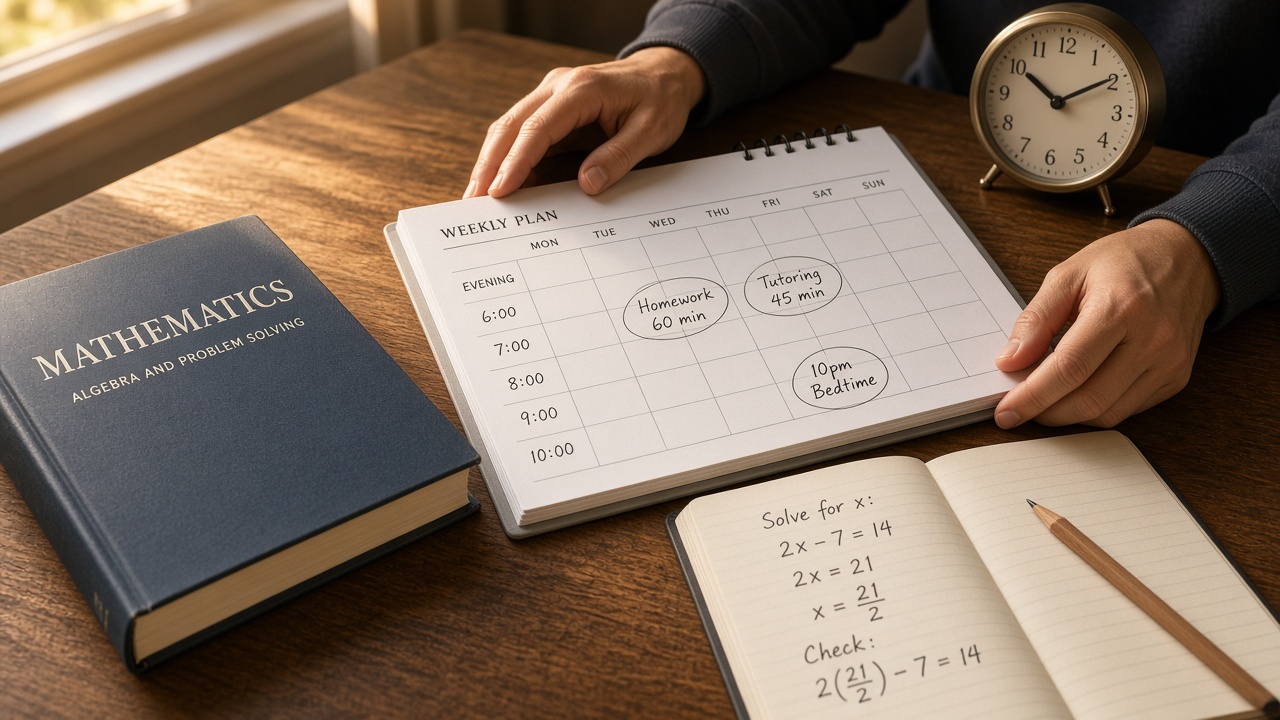
A long school day can be followed by homework, private tutoring, exam preparation, and extra practice. For Lebanese parents, especially in middle and secondary school, it can be difficult to tell where productive effort ends and overload begins.
There is no scientifically established number of daily academic hours that is healthy for every child.
What the evidence does support is a more useful approach: judge workload by age, sleep, recovery time, the quality of the work, and whether extra academic time is still producing meaningful progress.
More study is not automatically better. If homework and tutoring are regularly replacing sleep, causing persistent distress, or adding hours without improving understanding, the schedule deserves a second look.
This article provides general educational guidance, not a diagnosis. Persistent anxiety, major changes in mood or behavior, recurring physical complaints, or other health concerns should be discussed with a pediatrician, psychologist, or another qualified professional.
Is there a recommended amount of homework by grade?
One of the best-known homework guidelines is the “10-minute rule”: approximately 10 minutes of homework per grade level on a typical school night.
That would mean roughly:
| Grade | Approximate nightly homework under the rule |
|---|---|
| Grade 6 | 60 minutes |
| Grade 7 | 70 minutes |
| Grade 8 | 80 minutes |
| Grade 9 | 90 minutes |
| Grade 10 | 100 minutes |
| Grade 11 | 110 minutes |
| Grade 12 | About 120 minutes |
The rule is associated with the work of education researcher Harris Cooper, whose reviews found stronger evidence for homework benefits in secondary school than in the early grades. Cooper has described the guideline as fitting the broad pattern in the research while warning that assigning substantially more can produce diminishing returns and additional stress.
The important limitation is that this is a rule of thumb, not a medical limit or a universal prescription.
It does not account for differences in subject difficulty, learning needs, assignment quality, language of instruction, exam season, or how quickly individual students work. Sixty minutes of focused, appropriately difficult work is not equivalent to sixty minutes spent confused, distracted, or repeating material the student already understands.
Source: National Education Association — The Great Homework Debate.
What does newer international evidence say?
The latest OECD PISA data reinforce the idea that the relationship between homework time and performance is not linear.
In PISA 2025, students across OECD countries reported spending about 1.4 hours per day on homework on average. The OECD found an inverted-U relationship between homework time and science performance: performance rose with homework time up to around two hours per day, but students reporting more than two hours tended to have lower performance.
That does not prove that two hours is an ideal maximum or that longer homework directly causes lower scores. The OECD explicitly notes an important alternative explanation: students who are struggling may simply need more time to complete the same work.
The practical point is narrower:
Beyond a certain point, adding time does not reliably mean adding learning.
Source: OECD — PISA 2025 Results, Student School Life and Beyond.
Earlier PISA 2022 data showed a similar pattern, with mathematics performance positively associated with homework up to two hours per day on average across OECD countries.
Source: OECD — PISA 2022 Results, Volume II.
Homework is only part of the workload
This is where parents can easily underestimate what a student is carrying.
A child may have seven hours of school, commute time, 90 minutes of homework, a one-hour tutoring session, test preparation, and then another assignment before bed.
Research gives us reasonably good information about homework, sleep, stress, and tutoring separately. What it does not give us is a validated formula such as:
School + homework + tutoring should never exceed X hours per day.
There is no strong evidence for a universal cutoff like that.
So when tutoring is added, parents should not evaluate it in isolation. The relevant question is:
What is the child's total academic day, and what is being displaced to make room for the extra session?
If tutoring replaces inefficient independent struggle and helps the student finish work more effectively, it may reduce overall pressure.
If it is simply added on top of an already overloaded evening, it may do the opposite.
That distinction matters more than the number of tutoring sessions alone. For Grade 7–9 families asking about weekly session count rather than total evening load, see how many tutoring sessions a Brevet student needs.
Sleep should be treated as a requirement, not leftover time
For students in Grades 6–12, sleep provides one of the clearest boundaries parents can use.
The American Academy of Sleep Medicine recommends:
- Ages 6–12: 9–12 hours of sleep per 24 hours.
- Ages 13–18: 8–10 hours of sleep per 24 hours.
Adequate sleep is associated with better attention, learning, memory, emotional regulation, and overall health.
Source: American Academy of Sleep Medicine — Pediatric Sleep Recommendations.
This is particularly important because extra studying can directly compete with sleep.
A longitudinal study of 535 American adolescents found that when students sacrificed sleep to study more than they normally did, they were more likely to have difficulty understanding material in class and to struggle on an assignment or test the next day. Gillen-O'Neel, Huynh & Fuligni, Child Development, 2013.
A separate study of 1,225 adolescents in Singapore found that longer homework and study time was associated with less time in bed. Longer study time was also associated with higher depression-symptom scores, although the study was cross-sectional and therefore cannot establish that homework caused those symptoms. Yeo et al., Sleep Health, 2020.
The practical implication is straightforward:
If additional tutoring routinely requires a teenager to cut an eight-hour sleep opportunity to six or seven hours, that is not a neutral trade.
When does academic pressure become a concern?
Academic pressure is not automatically harmful.
Deadlines, difficult exams, and challenging subjects are normal parts of education. Some stress can occur during periods of high demand without indicating a psychological disorder.
The concern is persistent pressure without adequate recovery.
A 2023 systematic review by Thomas Steare and colleagues examined 52 studies of academic pressure and adolescent mental-health outcomes. Forty-eight found an association between academic pressure or periods of the school year and at least one mental-health outcome.
However, the authors were careful about causality: 39 of the 52 studies were cross-sectional, so the review cannot prove that academic pressure directly caused the mental-health problems observed. Steare et al., Journal of Affective Disorders, 2023.
WHO's 2021/2022 Health Behaviour in School-aged Children study also found rising perceived school pressure across participating countries and regions, particularly among older adolescents and girls. WHO Europe — Adolescent Social Contexts, 2024.
These findings support taking sustained academic pressure seriously. They do not justify diagnosing a child with anxiety, depression, or burnout based on workload alone.
What can academic overload look like?
There is no single symptom that proves a child has too much homework or tutoring.
Pediatric guidance suggests looking for patterns and changes from the child's normal behavior.
Children's Health, citing pediatric psychologist Dr. Hillary Kimbley, lists signs that can appear when children are overscheduled or overwhelmed, including:
- unusual irritability or mood swings;
- increased anxiety;
- declining school performance;
- loss of interest in activities they previously enjoyed;
- headaches or stomachaches;
- difficulty sleeping.
Source: Children's Health — Is My Child Overscheduled?
These are warning signs, not diagnostic criteria. Headaches, sleep difficulties, anxiety, irritability, and falling grades can have many causes.
If such changes are persistent, severe, or interfering with daily life, the appropriate next step is not to diagnose the problem at home. It is to speak with the child's school and, where appropriate, a pediatrician or mental-health professional.
More pressure can also undermine motivation
Parents naturally want children to take school seriously. But there is a difference between structure and control.
Self-Determination Theory, developed principally by psychologists Richard Ryan and Edward Deci, proposes that motivation and well-being are supported when three psychological needs are met:
- autonomy — experiencing some ownership over one's actions;
- competence — feeling capable of improving and mastering challenges;
- relatedness — feeling supported and connected to others.
Their research distinguishes motivation that students internalize and value from behavior driven primarily by external control. Ryan & Deci, American Psychologist, 2000.
A 2022 meta-analysis covering 144 studies and more than 79,000 students found that autonomy-supportive environments were associated with greater psychological-need satisfaction and more self-determined motivation. Bureau et al. — Pathways to Student Motivation: Meta-analysis.
More recent research has also linked parental autonomy support with stronger academic motivation in adolescents. Çelik, Frontiers in Psychology, 2024.
This does not mean parents should remove expectations.
It means effective academic support should increasingly help adolescents plan, choose strategies, understand consequences, and build independence rather than making every academic decision for them.
What does the evidence say specifically about Lebanon?
Lebanon-specific evidence on combined school + homework + tutoring workload is limited.
We did not find a strong national dataset establishing how many hours Lebanese students spend across all three or identifying a Lebanese-specific threshold for “too much.”
One 2022 study examined 119 Grade 12 Life Sciences students across seven public and private secondary schools in Saida, Tyre, and Nabatieh. It reported academic overload and an association between information overload and poorer reported mental and physical well-being.
This is relevant local evidence, but it is one relatively small regional study and should not be generalized to every Lebanese student. Mazen Ismail, International Journal of Education, Technology and Science, 2022.
A 2026 AUB graduate study of 40 Grade 4 students in one private Beirut school found no statistically significant grammar-achievement advantage from homework after baseline differences were adjusted for. Teachers interviewed in the same study raised concerns about psychological balance and burnout. Again, this is useful local work, but the sample is too small and too young to define a national workload policy for Grades 6–12. AUB ScholarWorks — Nour Haidar, 2026.
So claims that Lebanese students need a particular number of homework or tutoring hours because the curriculum is “harder” should be treated cautiously unless a school can support them with evidence.
A practical workload check for parents
Rather than searching for one magic number, review the child's week across five areas.
1. Sleep
Can the child consistently obtain the recommended sleep for their age?
If not, identify what is pushing bedtime later before adding more academic time.
2. Progress
Is the extra homework or tutoring producing a measurable improvement in understanding, independence, accuracy, or school performance?
If hours keep increasing while progress stays flat, the solution may be a different learning strategy rather than more time.
3. Recovery
Does the student still have regular time to eat properly, move, socialize, relax, and spend some time without scheduled academic demands?
Downtime is not wasted time.
4. Behavior and wellbeing
Has the student become persistently irritable, anxious, exhausted, disengaged, physically uncomfortable, or unable to sleep?
Look for sustained changes rather than one difficult week before an exam.
5. Independence
Is tutoring helping the student become more capable without the tutor?
Effective academic support should gradually build competence. If a child cannot begin homework, revise, or solve familiar problems without continuous adult assistance, the current support structure may need to be reviewed.
What should parents do if the schedule looks excessive?
Start by mapping the entire week.
Include school, transport, homework, tutoring, exam preparation, extracurricular activities, meals, bedtime, and wake time. Problems are often easier to see when the schedule is written down.
Then identify the academic bottleneck.
If mathematics homework takes two hours because the student does not understand one core concept, targeted support may be more useful than simply extending homework time. If three tutors are independently assigning additional exercises, coordination may reduce duplication.
Parents can also speak with teachers about how long assignments are expected to take. A task designed for 40 minutes that consistently takes a child two hours may indicate a learning gap, unrealistic workload, inefficient study habits, distraction, or another issue worth investigating.
For students who need additional academic help, the goal should be structured support that improves efficiency and independence, not simply filling every available evening hour. Mou3alem’s Academic Support and Structured Method pages explain how targeted support can be organized around specific learning needs.
And if persistent distress, sleep disruption, recurrent physical complaints, major mood changes, or significant functional problems are present, speak with a qualified health professional.
So how much homework and tutoring is too much?
There is no universal hourly cutoff.
The evidence points instead to several boundaries:
- Homework has diminishing returns; international PISA data do not show a simple “more is better” relationship.
- The 10-minute-per-grade rule can be a rough reference point, not a strict prescription.
- Tutoring should be considered part of the student’s total workload, not treated as free additional time.
- Sleep requirements should not be sacrificed to create more study hours.
- Persistent distress, physical complaints, disengagement, or deteriorating performance deserve attention.
- Extra academic time should have a defined purpose and should lead toward greater independence.
For Lebanese parents, the most useful question is therefore not:
“How many hours should my child study?”
It is:
“Is the current workload helping my child learn effectively without consistently displacing the sleep, recovery, and wellbeing they need to keep learning?”
That is a much better boundary than maximizing the number of hours a student can tolerate.
If the current schedule is adding hours without adding independence, start with a diagnosis rather than another evening slot. Book an assessment to identify the gap and set structured support around it.
FAQ
Is two hours of homework per night too much?
Not automatically, particularly for older secondary students. But OECD data show that the relationship between homework and performance is not linear and becomes negative beyond roughly two hours per day at the population level. That is an association, not an individual medical cutoff.
Should tutoring count as homework time?
For workload planning, yes. Tutoring and homework are different activities, but both use the student’s after-school academic time and compete with sleep, meals, recreation, exercise, and family time.
Is tutoring harmful if my child is already stressed?
Not necessarily. Effective tutoring can reduce stress if it resolves confusion and makes independent work more efficient. It can add pressure when it simply extends an already overloaded schedule. The purpose and total workload matter.
How much sleep should a teenager get?
The American Academy of Sleep Medicine recommends 8–10 hours per 24 hours for ages 13–18. Children ages 6–12 should generally get 9–12 hours.
Are headaches or irritability proof of academic burnout?
No. They are nonspecific signs with many possible causes. If they persist, worsen, or interfere with daily functioning, consult an appropriate healthcare professional rather than assuming academic overload is the diagnosis.